Live it first — whether you're growing where you are
Step into a realistic AI-run simulation of the real thing — the interview, the role, the decision — and see exactly how you'd actually perform, before it's real.
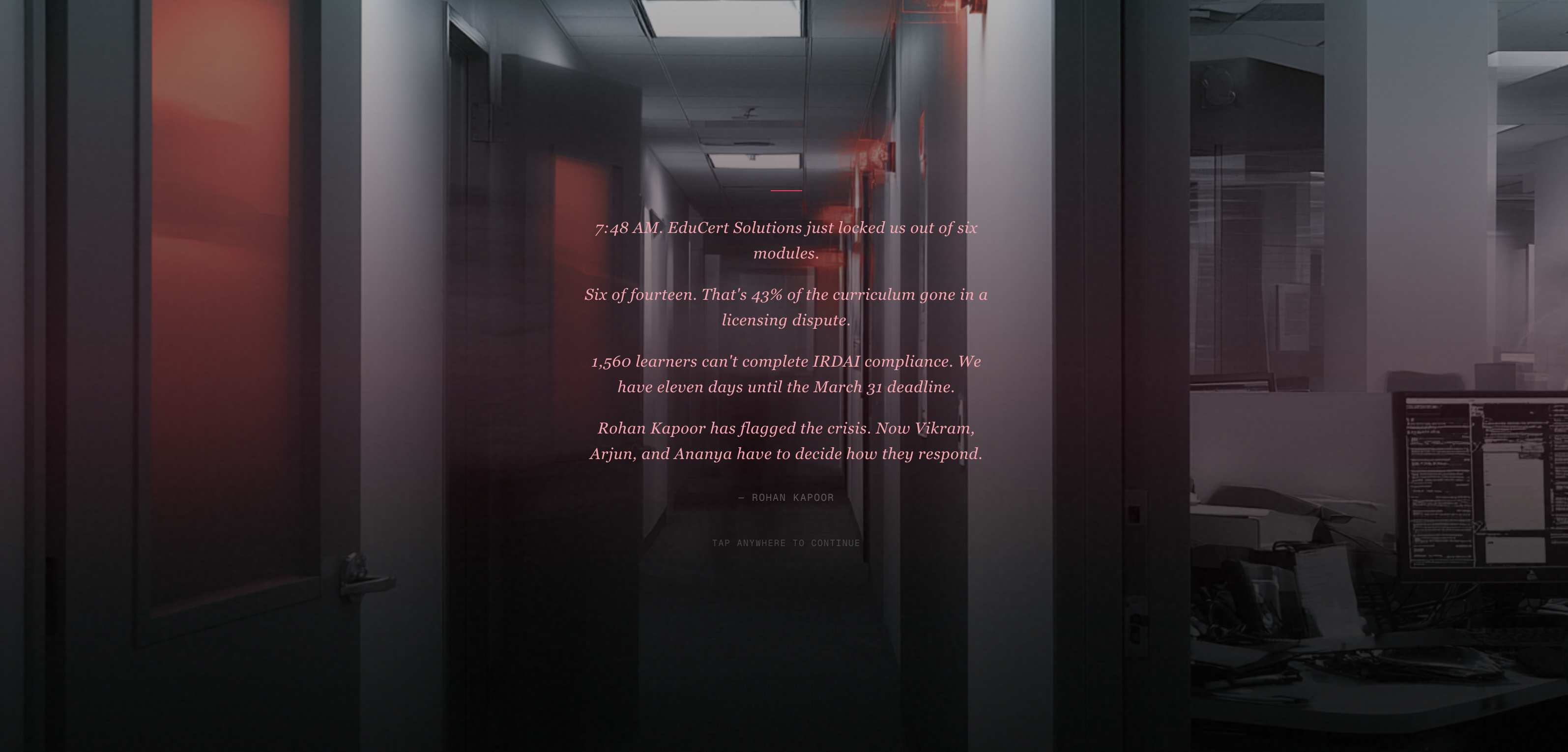
Rohan Kapoor has flagged the crisis. What's your call?
A simulation starts with a moment that matters.
This preview is intentionally simple. The real experience uses context, consequences and branching decisions to reveal how you think when the answer isn't obvious. This is a real scenario from PRISM.
6 of 14 IRDAI modules just got locked. 1,560 learners can't complete compliance training.
EduCert Solutions suspended access over a licensing dispute — no warning. Rohan Kapoor has flagged the crisis. Now you decide how to respond, before it reaches the CEO.
One experience.
Four layers of evidence.
The product makes more sense when you see the chain at full scale: enter a realistic situation, make consequential choices, inspect what those choices reveal, then turn the gaps into something you can work on.
Live simulation
You step into the work.
The experience opens inside the role itself. Context, pressure, competing priorities and real signals are already in motion before you make a single decision.
 Decision trail
The decision leaves a trail.
What matters is not simply whether an answer was right. Lifecraft captures the choice, the timing, the trade-offs and the observable signals around it, so the later report has something concrete to point back to.
 Your report
You get named, not numbered.
The report resolves into an identity you can actually carry — an archetype built from the pattern across your decisions, not a single isolated score.
 Development plan
Your gaps get their own tasks.
Every weak spot becomes a specific, targeted follow-up — reading, practice, or another round — so the gap doesn't just sit there named. It gets worked on.
Same simulation engine. Three different reasons to use it.
 Facet
FacetKnow what you're capable of. Prove it.
Build an evidence-based record of your strengths — traced to real decisions, not self-report.
 Livit
LivitWalk into your interview already knowing how it goes.
A simulation built for that exact role — so nothing about the real thing catches you off guard.
 Preflight
Live a career before you choose it.
Explore real roles across industries, and know how they actually feel — before you commit years to one.
Confidence isn't a mindset.
It's what's left when the unknown runs out.
Most of what feels like nerves is really just not knowing — what the room will feel like, what they'll ask, what you'll do under pressure. Practice removes that. And once you've seen exactly where you stand, there's nothing left to guess about — just the version of you that already showed up once.
Practice kills unpredictability
You've already been in the room. Nothing about the real one will be new.
Evidence kills guesswork
You already know your strengths and your gaps — not a feeling, a finding.
You don't have to take our word for it.
The report is not a decorative scorecard. Every conclusion is built from observable moments inside the simulation — so you can move from the summary back to the competency, the action record, and the evidence behind it.

Observed, not self-reported
The profile starts with what you actually did under pressure, not what you say you would do.
Every score, cited
Click into any finding and see the exact decision it came from.
Built in the open
This is early. We're building the track record as real people use it — not claiming one we don't have yet.
Your team is already forming opinions about their strengths. Give them evidence instead of guesses.
Whether you're developing the people you have or evaluating the people you're choosing between, Lifecraft turns real simulated decisions into a signal you can actually act on.
Talk to us about organisations →Sponsor Facet for your team — development, not evaluation, by design.
License Preflight for your students — real role exposure, at scale.
Don't guess what you're ready for.
Live it first.
Step into the role, make the decisions, and walk away with evidence of how you actually showed up.
Start your first simulation →